Fresh paint on one wall only
A single repainted basement wall, ceiling panel or closet in a house nobody else has touched. Sometimes it is innocent. Sometimes it is a stain-blocker over a leak that is still happening.
Before you buy the house
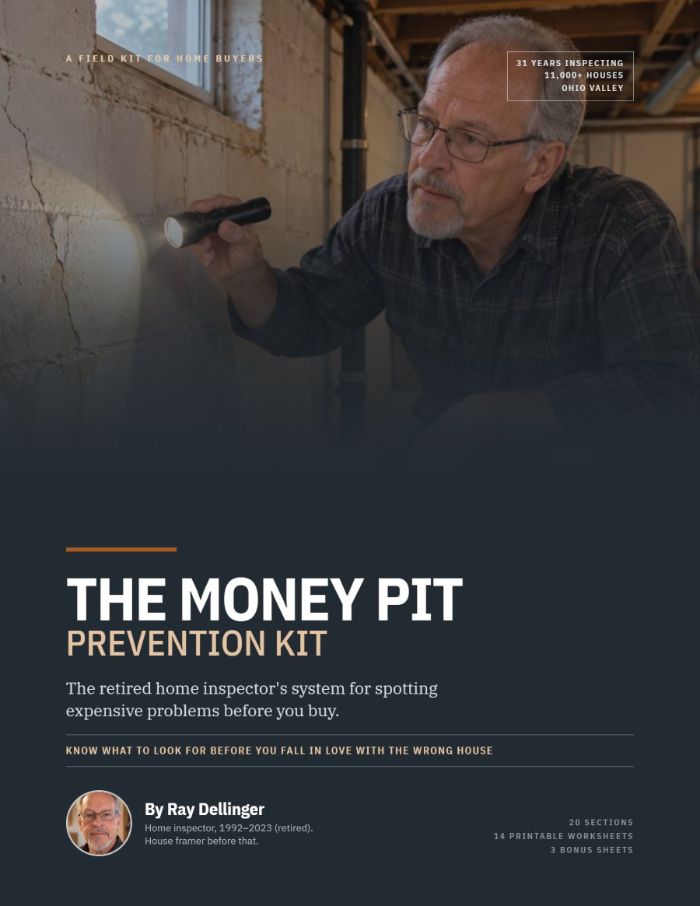
The Money Pit Prevention Kit gives buyers a practical system for spotting expensive warning signs, asking better questions, and knowing when a problem deserves a closer look — built from 31 years and more than 11,000 home inspections.
A $47 decision tool for a purchase that may cost you hundreds of thousands of dollars.

The part buyers miss
Most buyers notice countertops, flooring, paint, bedrooms and appliances. Ray spent 31 years looking at the things underneath them.
A single repainted basement wall, ceiling panel or closet in a house nobody else has touched. Sometimes it is innocent. Sometimes it is a stain-blocker over a leak that is still happening.
The cabinets are three months old. The drain lines under the slab are sixty years old. Renovations sell houses; drain lines, panels and footing drains do not.
Nearly every foundation has a crack in it, and most are harmless. Direction and displacement are what separate a maintenance item from a structural engineer's phone number.
"Does it leak?" gets an honest no. "How many years are left?" is the question that has a five-figure answer, and almost nobody asks it before the offer.
The cheapest problem on this list and the cause of the most expensive ones. Water goes where the dirt sends it, and the dirt is in plain sight from the driveway.
A renovated house can be an excellent buy. The risk is that new finishes hide everything that was there before — and you now have no worn surfaces prompting you to ask questions.

"I've stood in a basement with water running down a wall while somebody told me about their plans for the dining room." Once your brain decides it's your house, every problem gets quietly filed as "we'll deal with that."
What the kit actually teaches
Every house has a list. Some items are cosmetic. Some are negotiation points. Some need a specialist. And a few change whether the deal makes financial sense at all. The whole job is telling them apart.
Common imperfections that often look worse than they are.
Real findings that need more information before you can price them.
Stop looking and bring in the right qualified expert.
Who made this
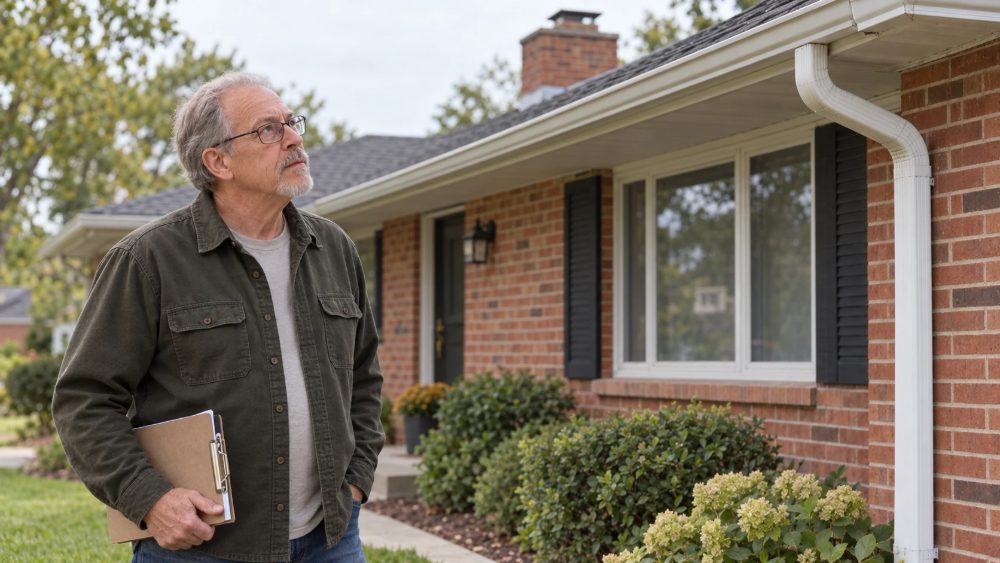
Ray Dellinger inspected homes throughout the Ohio Valley for 31 years and walked through more than 11,000 houses — farmhouses, post-war ranches, split-levels, city doubles, and a great many ordinary three-bedroom houses somebody was about to make the biggest financial decision of their life over.
Before he ever inspected a house, he framed them for nine years. That is the part he leans on most: it taught him what goes behind a wall before anybody closes it up, and what gets skipped when a crew is behind schedule and it is going to rain.
He retired in 2023 and deliberately allowed his professional licenses to lapse. Today he has no inspection appointment to sell you, no contractor estimate waiting, and no reason to talk you into or out of any property. He built this kit around the questions he wishes more buyers had asked before they committed.
"The goal isn't to find a perfect house. It's to understand the expensive problems before they become yours."
Ray Dellinger
Ray is retired and is not currently licensed. This kit is educational and does not replace a professional home inspection or specialist evaluation.
What's inside
98 pages, 20 sections, and 14 printable worksheets. Built to be used in a driveway and a basement, not read once and forgotten.
Four printable sheets you carry through a property, room by room. Mark every item OK, question, concern, or needs a professional — so nothing depends on what you can remember in the car afterwards.
IncludedDiagrams of the four crack patterns and what each one usually means. Ray's rule of thumb: width tells you little, direction tells you a lot, displacement tells you almost everything.
This guide does not diagnose structural problems. It helps you recognize when to ask for a professional evaluation.
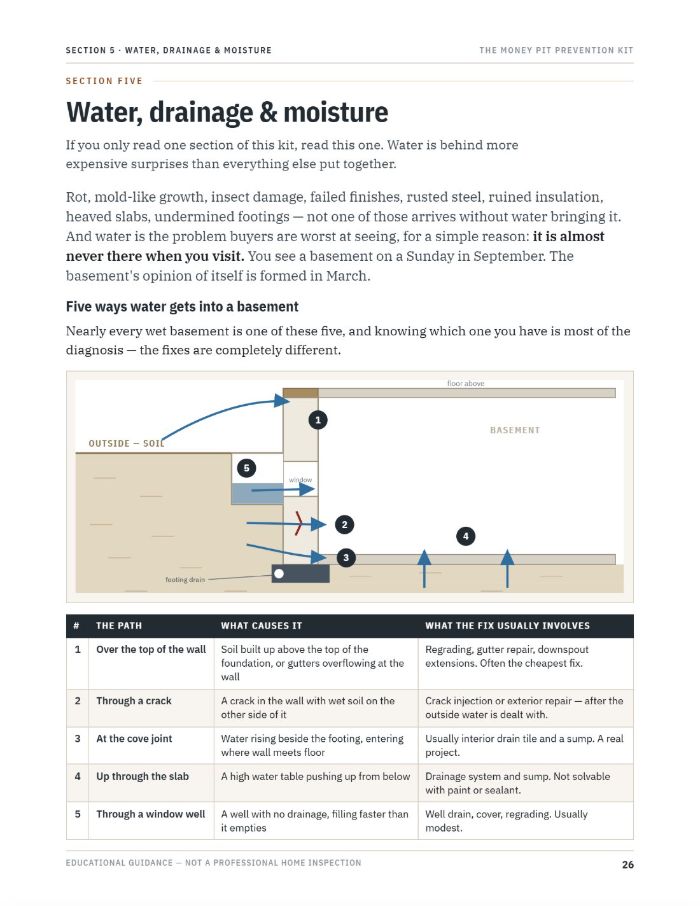
IncludedThe strongest section in the kit. Five questions that follow water's own logic, plus a cutaway diagram of the five ways it actually gets into a basement — and how to read a basement that happens to be dry the day you visit.
IncludedNot every flip is bad — plenty are excellent. The risk is cosmetic work covering everything underneath it. This section shows you how to judge workmanship without knowing a thing about construction, and what to ask in writing.
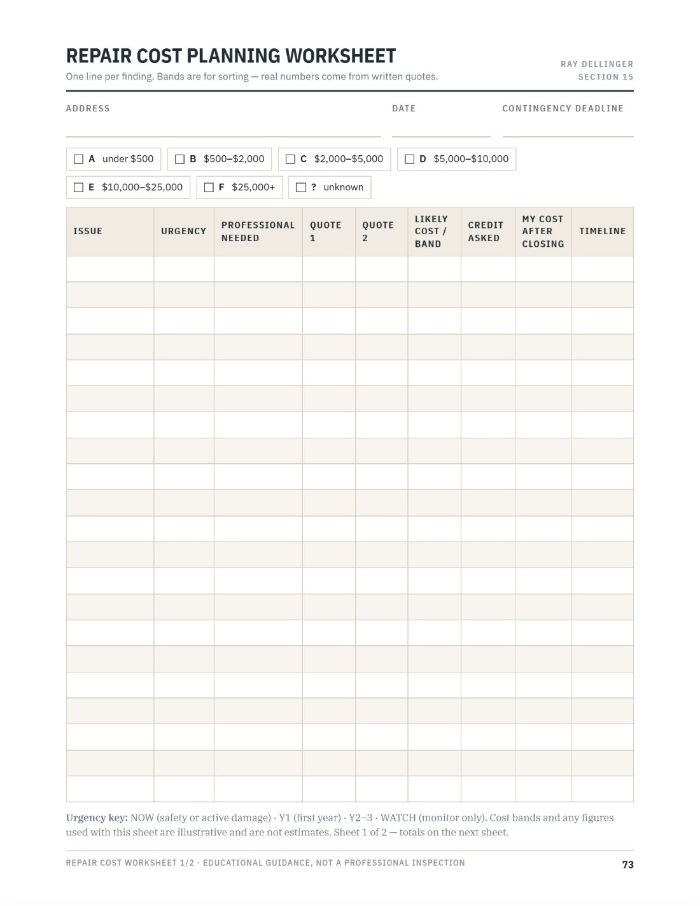
IncludedWhere a pile of worries becomes a list with numbers next to it — the only form a worry can be negotiated in. Uses honest cost bands rather than invented national prices.
IncludedTwo printable sheets to send through your agent, in writing, with room to record the answers. The seller knows things no inspection will ever find.
IncludedThe most valuable hour in the whole process, and most buyers waste it. Twelve questions with space to write the answers down while you are both still standing in the house.
Pre-1940 through the 1990s and after — what is worth checking in each period, phrased as items to look at rather than problems to expect. Plus a plain-language section on environmental items where the only correct action is "don't touch it, call somebody."
IncludedSee what you're getting
Not mockups. These are actual pages — click any one to look closer.
Previews are a sample. The kit is 98 pages.
Also included
Bonus 01
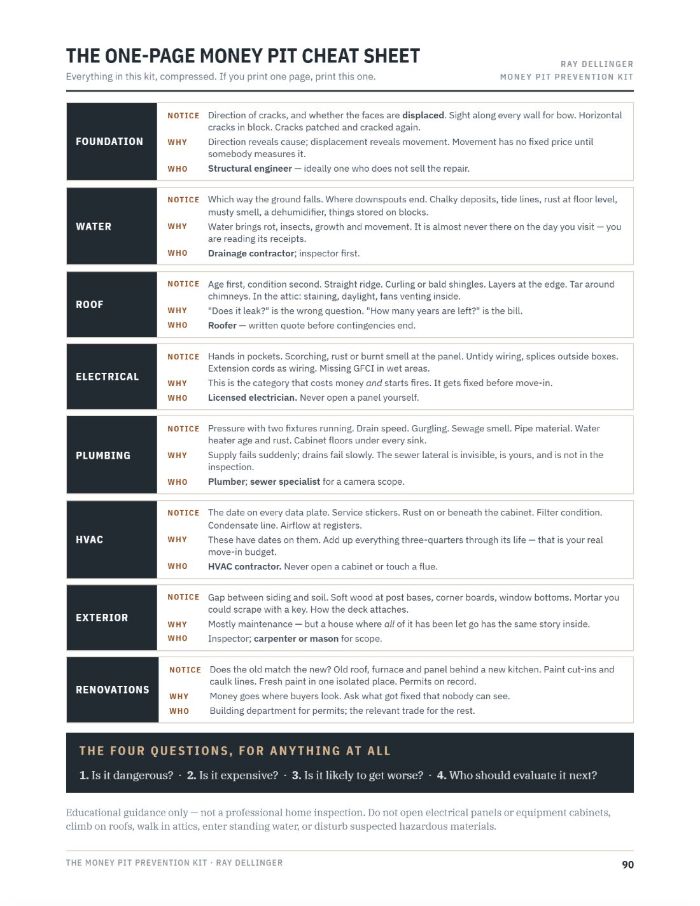
Every system on a single page — what to notice, why it matters, who to call. Made to live on your phone.
Bonus 02
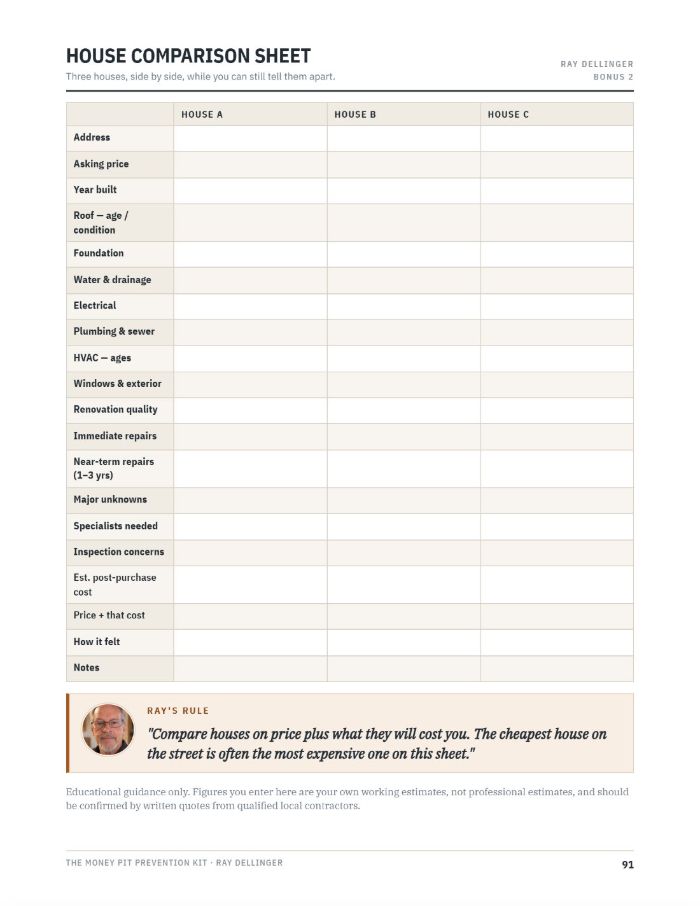
Three houses side by side, compared on price plus what each will cost after you own it.
Bonus 03
Check the property one more time before closing, when you still have leverage.
Bonus 04
One per house. Concerns, questions, photos to review, and estimated repair exposure.
Worth framing honestly
A roof, a foundation, a sewer line, a drainage problem, an HVAC replacement or a poorly executed renovation can materially change what a house actually costs you. Not one of those shows up on a listing.
$47
One-time · instant access
Get the KitIt is designed to help you ask better questions before a purchase that may cost hundreds of thousands of dollars.
What changes
No kit can promise certainty about any property. What this one does is make sure the questions get asked while you can still act on the answers.
Why trust this
We're not going to show you made-up testimonials or a fake customer counter. Until verified buyer feedback exists, here is the honest case.
Placeholder — replace before launch
[INSERT VERIFIED CUSTOMER TESTIMONIAL]
Placeholder — replace before launch
[INSERT VERIFIED CUSTOMER TESTIMONIAL]
Placeholder — replace before launch
[INSERT VERIFIED REVIEW SCREENSHOT]
Fair questions
The Money Pit Prevention Kit is not designed to replace your inspector, and Ray would tell you to hire one for every purchase without exception. It is designed to make that inspection worth more to you. It helps you:
An inspection covers one house, once. The kit is with you from the first showing to the final walkthrough — and on to the next house if this one doesn't work out.
Good — it is written for buyers, not contractors. Nothing in it asks you to open a panel, climb on a roof, or fix anything. It is about looking and asking.
Newer houses still have drainage, roofing, installation, electrical, moisture and workmanship issues. A house from the late 1990s is already due for its second roof.
There's a full section on old houses, era by era, covering what is worth checking from pre-1940 onward — phrased as items to look at, not problems to assume.
Then use it now: before your inspection, during inspection follow-up, when you're deciding what to ask the seller for, and again at the final walkthrough.
No. It is an educational tool. Safety, structural, electrical, plumbing, environmental and roofing concerns should be evaluated by appropriately qualified professionals.
No, and it deliberately refuses to. There is no score that can weigh a bowed wall against a school district. It organizes what you know so the decision is yours to make properly.
If you go through the kit and decide it isn't useful for your home-buying process, contact us within 30 days for a refund.
Questions
No. It is educational material, and it is not a home inspection, an engineering assessment, or a repair estimate. Ray's advice is to hire a qualified home inspector for every purchase and to attend the inspection. This kit helps you get more out of that inspection — it does not stand in for it.
No. Ray retired in 2023 and deliberately allowed his home inspector license and his earlier contractor registration to lapse. He is not licensed, and he is not available for inspections. That is intentional: he has nothing to sell you beyond this kit.
No. Second-time buyers, people helping adult children buy, long-term renters and existing homeowners buying again all use the same checklists. If anything, people who have bought before tend to find the cost planning and comparison worksheets most useful.
Yes — there is a full section on old houses covering pre-1940 through the 1990s and after, listing what is worth checking in each era. It is careful to frame these as items to look at rather than problems every house from that period has.
Yes, and there is a dedicated section for it. It is fair about flips — plenty are excellent work. The section is about telling the difference, judging workmanship without construction knowledge, and asking the right questions in writing.
It includes planning tools and broad cost categories rather than specific prices, and they are clearly labelled illustrative. Real costs vary enormously by region, access, scope, materials and timing. The kit's position is that a number printed in a book about a house nobody has seen is worse than no number at all — so it teaches you to get written quotes instead.
Yes. Every page is laid out for US Letter, and 14 worksheets are designed to be printed on their own — so you can print just the Showing Checklist without printing 98 pages. There is also a PDF of the whole kit.
Yes. The digital version reflows for phone screens, and the checklists are tickable on screen with notes you can type — useful when you are standing in a basement without a clipboard.
Before showings, while comparing homes, before your inspection, when reviewing the inspection findings, while deciding what to ask the seller for, and during the final walkthrough. It is built for the whole process rather than one moment in it.
No — and it refuses to on purpose. Section 19 explains why: no score can weigh a bowed foundation wall against a kitchen you love, a commute you can live with, and a rate you already locked. What it does is organize the information and the unanswered questions so you can make that decision yourself, with appropriate professional input.
It is a digital product — you get access immediately after checkout. It reads in any browser on desktop, tablet or phone, and includes a print-ready PDF plus the individual printable worksheets.
One last thing
Buying a home should be exciting. But excitement should not stop you asking uncomfortable questions while you still have the chance to act on the answers.
The best time to find a problem is before your name is on the deed. Once you close, the repair belongs to you.
"You are not trying to find a perfect house. You are trying to find out what the house is going to cost you after you own it."
Ray Dellinger — Ohio Valley
Free from Ray
Not ready to buy the kit? Take the short version. Fifteen things worth checking on any house, in one page you can keep on your phone.
The checklist is on its way. If it doesn't arrive in a few minutes, look in your spam folder.